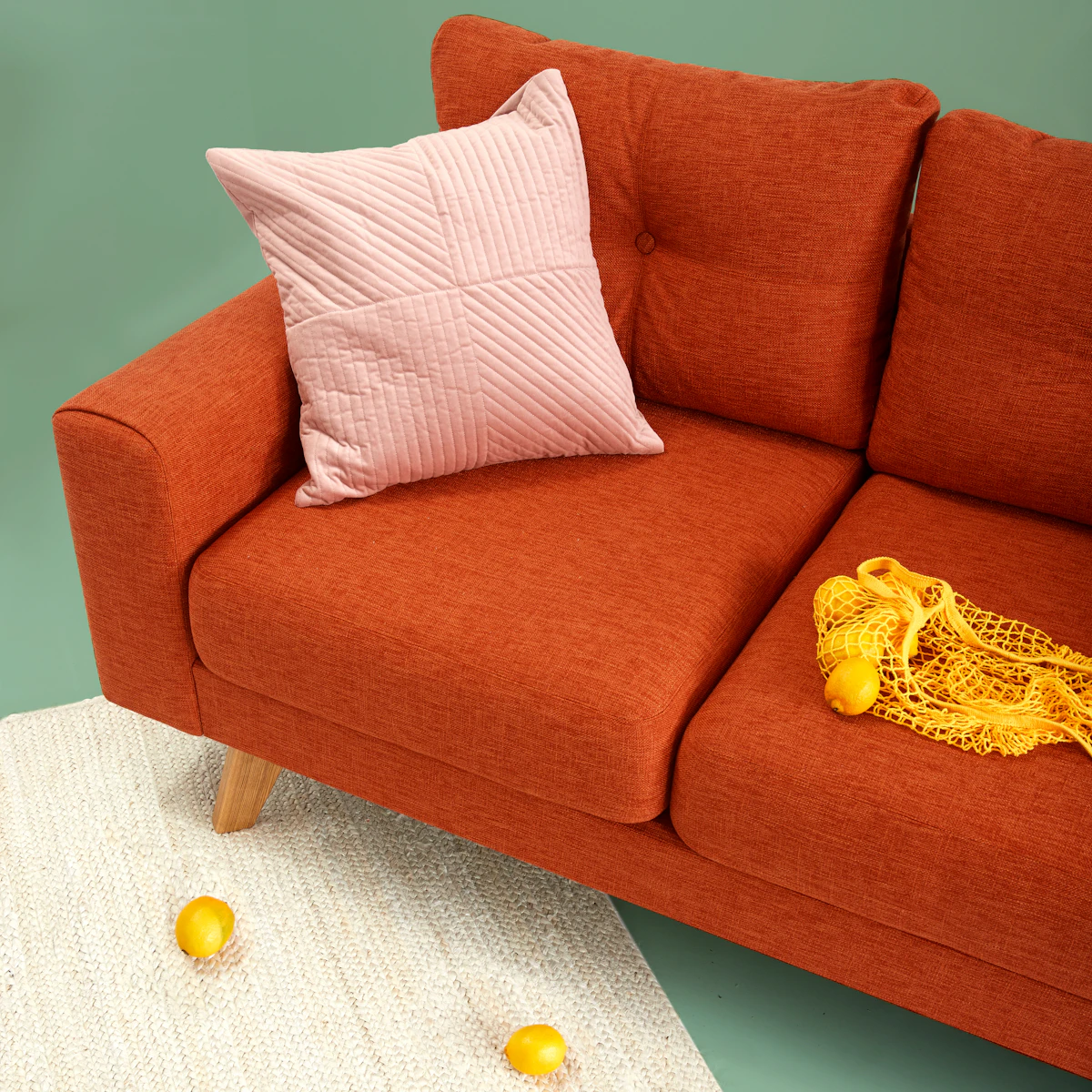
These two get confused constantly, and the confusion is understandable — both are twentieth century, both are geometric, both are sold under the same "modern classic" heading by shops that stock neither properly. But they are twenty years and one world war apart, they were made for different rooms by different people for different reasons, and they behave differently when you live with them.
Choosing between them is not a matter of taste alone. In a Lahore house, with the ceiling heights and room proportions we actually build, one of them consistently works better. I will get to which.
The one-sentence version
Art Deco is pre-war luxury: heavy, symmetrical, grounded, made from expensive materials by hand for people who wanted the room to know it. Mid-century modern is post-war optimism: light, asymmetric, raised on legs, designed for mass production and small houses.
Everything else follows from that. Deco is about mass and material; mid-century is about lightness and honesty. One says "this was made for you". The other says "anyone can have this, and that is the point".
Proportion — where the difference actually shows
If you learn one distinction, learn this one. Deco furniture is grounded: a case piece sits on a plinth, and the plinth reads as a base. Mid-century furniture is raised: a case piece sits on splayed legs, and the floor runs underneath it.
| Art Deco (1920–1940) | Mid-century (1945–1965) | |
|---|---|---|
| Base | Solid plinth, 8–14cm, visible | Splayed or tapered legs, 15–25cm of air |
| Seat height | 38–42cm | 40–44cm |
| Case height | 78–86cm, wide | 70–80cm, long and low |
| Line | Horizontal, banded, stepped | Horizontal, uninterrupted, floating |
| Symmetry | Strict, usually axial | Deliberately asymmetric |
| Materials | Walnut, macassar, burl, brass, marble, lacquer | Teak, rosewood, plywood, steel, moulded plastic |
| Ornament | Integral — the veneer, the profile | Almost none; the joint is the ornament |
| Made by | Hand, in small numbers | Machine, in large numbers |

Where they came from
Deco: 1925, and the last great age of cabinetmaking
Deco was made for the drawing rooms of people who had staff. It emerged from Parisian ateliers where a single cabinet could occupy a workshop for a season, and it borrowed its vocabulary from everything that felt modern in 1925 — ocean liners, aviation, Cubism, Egyptology after Tutankhamun, and the geometric arts of Africa and Mesoamerica. It reached the subcontinent within a decade and adapted immediately, which is the subject of Art Deco is already in Lahore.
Mid-century: 1945, and the problem of housing everybody
Mid-century came out of the opposite condition. Post-war America and Scandinavia needed enormous quantities of furniture for small new houses, quickly and affordably, and a generation of designers took the industrial techniques developed during the war — moulded plywood, bent steel, fibreglass — and turned them domestic. The aesthetic follows the manufacturing: thin, light, legged, unornamented, because that is what a press and a jig produce well.
How each one behaves in a room
This is the part that catalogues do not tell you, and it is the part that decides whether you are happy in three years.
- Deco anchors. A Deco console makes a hall feel resolved and permanent. Put four Deco pieces in one small room and it becomes solemn
- Mid-century lightens. Four mid-century pieces in a small room still feel airy, because you can see the floor under all of them
- Deco wants a tall ceiling and a generous room. Below about nine feet it starts to feel heavy
- Mid-century wants a low ceiling and a modest room, which is exactly what it was designed for. In a large double-height space it can look underscaled and slightly temporary
- Deco reads formal, which suits a room where guests are received. Mid-century reads relaxed, which suits a room where a family lives
The practical consequence is that most houses want both, in different rooms — Deco where you receive, mid-century where you actually sit. That is not a compromise; it is how the rooms are used.
Which suits a Lahore house?
A typical DHA house has ceilings of eleven to thirteen feet, generously proportioned formal rooms, hard floors — marble or porcelain — and a great deal of daylight. That specification is, almost line for line, what Deco was designed for.
Mid-century furniture in a twelve-foot room tends to look like it is waiting for the rest of the delivery. Its proportions assume an eight-foot ceiling and a carpeted floor; put it under a tall ceiling on polished marble and the thin legs and low backs read as insubstantial. It is not a failure of the design — it is a failure of the match.
There is also a straightforward material argument. Deco’s palette — solid timber, veneered case work, brass, marble, wool — handles our climate well when properly made. Mid-century’s signature materials include moulded plywood and fibreglass, and thin bent plywood in a house that swings from 8% to 70% relative humidity is not where I would put my money. More on that in monsoon humidity and wood movement.
Mixing them, without it looking like a shop floor
The two styles combine well because they share a horizontal instinct and neither one is fussy. Three rules keep the mix deliberate rather than accidental.
- Let one style lead. Roughly 70/30 by volume. A room split evenly reads as indecision
- Repeat one material across both — brass, or walnut, or black — so the eye finds a thread. The cocktail table does this in brass; a mid-century chair with brass ferrules answers it
- Keep the base heights consistent within a sightline. A plinth-based console beside a leggy sideboard on the same wall reads as a mistake; put them on different walls and it reads as curation
The piece that most often bridges the two is a compact upholstered chair on a low timber base — Deco in its proportion, mid-century in its lightness. The Wren sits deliberately in that gap.

What each one costs, and how it holds value
Genuinely made Deco is expensive because the techniques it depends on — radial veneer layup, hand-built lacquer, cast solid hardware — are labour, and labour has not become cheaper. Well-made new Deco holds its value in the way any hand-made object does: it can be refinished, reupholstered and repaired indefinitely.
Original mid-century by a named designer is a collectors’ market with its own economics. Reproduction mid-century is usually cheap because the whole point of the style was that it could be made cheaply, and the cheap versions use veneered particleboard, stapled joints and plated steel. They are pleasant for five years and disposable after that.
Deco was made to be owned for a lifetime. Mid-century was made so that everybody could own something. Both are honourable; only one of them was ever meant to be an heirloom.
If you are weighing a specific piece, the six checks in what makes a piece genuinely Art Deco apply equally to a mid-century reproduction. Frame, joint, substrate, hardware, finish. The style changes; the questions do not.