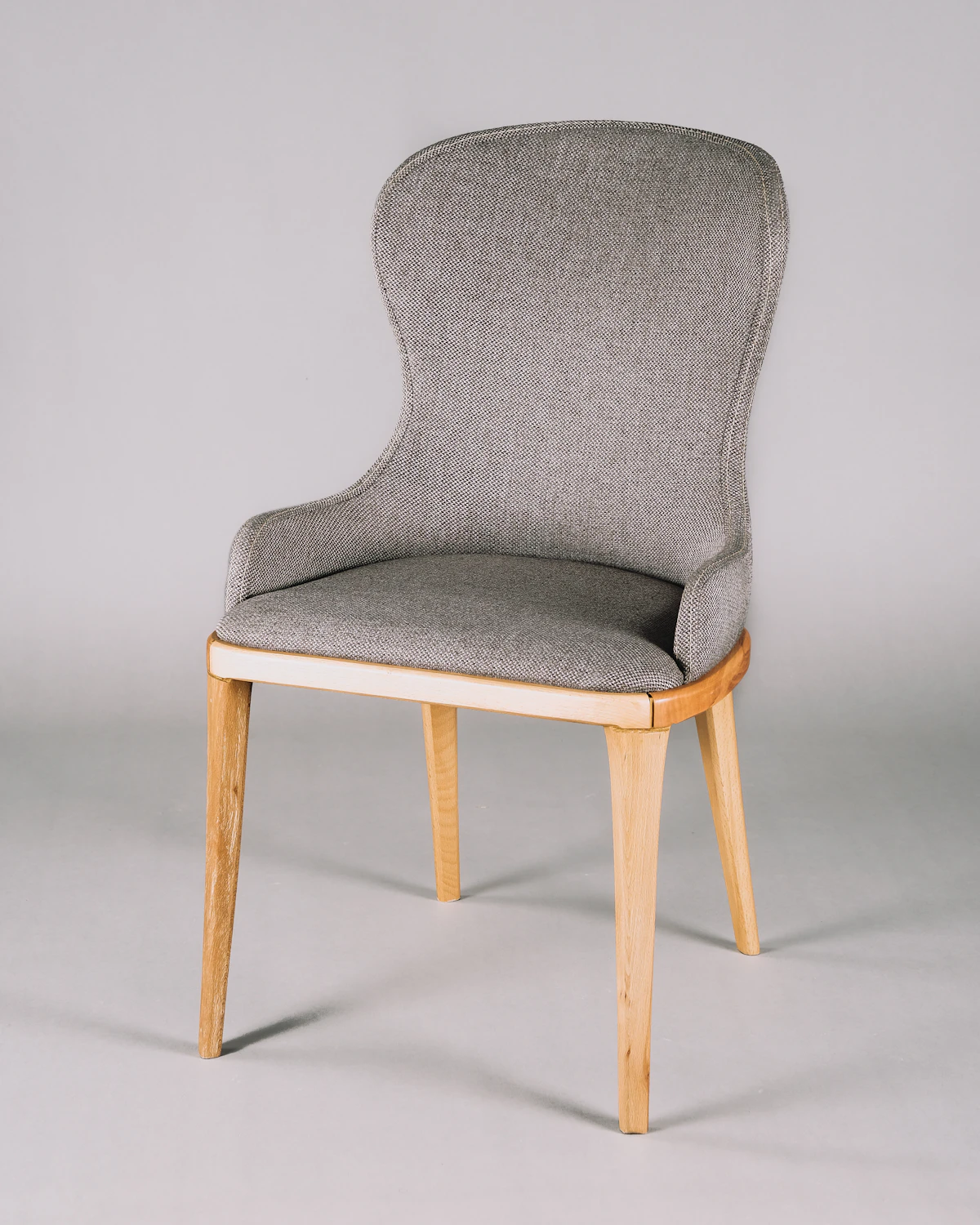
Lahore asks more of timber than most climates. Forty-five degrees and single-figure humidity in June; monsoon saturation in August; a dry, cool December with the heating on. Wood moves with moisture rather than heat, and that swing is what splits a tabletop or jams a drawer that worked perfectly in March.
Species matters. Seasoning matters more. Almost every failure I am asked to look at is a seasoning failure wearing a species costume, and the owner has usually been told the problem is the wood when the problem is the moisture content it was cut at.
First, the mechanism — why wood moves at all
Timber is hygroscopic: it gives up and takes on moisture until it is in equilibrium with the air around it. As it does, it changes dimension — barely at all along its length, noticeably across the grain, and most of all tangentially, along the growth rings. A 90cm-wide tabletop can move 6–10mm across its width between a Lahore June and a Lahore August. That is not a defect. That is what wood does, and furniture has to be built to allow it.
Equilibrium moisture content in an air-conditioned Lahore house sits at roughly 7–9% for much of the year and rises during monsoon. Timber cut at 18% will keep shrinking for months after it becomes furniture, and shrinkage that is restrained — by a fixed top, a tight tenon, a panel glued into a frame — has nowhere to go except into a split.
Sheesham — the local default, and its real trade-off
Indian rosewood, grown here, dense, hard-wearing and genuinely beautiful when the figure is good. It takes detail crisply, which is why the traditional carved furniture of this region is almost all sheesham. It is also the timber most often sold insufficiently seasoned, because demand outruns drying time and a plank that is still wet looks identical to one that is not.
Sheesham that went into a workshop at 18% moisture will move for years afterwards, and it is the single most common cause of the split tabletops I am asked to look at. Properly kiln-dried to 8–10%, it is excellent and locally sensible: no import cost, no shipping delay, and a density that resists the knocks a family house delivers.
One further point on sheesham that reputable dealers now take seriously: Dalbergia species are CITES-listed, and documented, legal sourcing is both an ethical and a practical matter if a piece is ever exported. Ask where it came from.

Walnut — stable, and worth the premium
American black walnut has notably low movement for its density, which is why it became the standard for fine furniture in climates with real seasonal swing. It machines cleanly, takes an oil finish beautifully, and darkens gently towards a warm brown rather than yellowing the way many timbers do under Lahore’s light.
It is imported and priced accordingly — expect a substantial multiple of local sheesham by volume. For a dining table, which is a single wide surface and therefore the piece most vulnerable to movement, it is the timber I specify most often. The Astor is walnut for exactly this reason.
A caution on colour: walnut lightens under strong UV rather than darkening, which is the opposite of what most people expect. A table under a south-facing window will fade unevenly if it is left uncovered for a year. This is a curtain problem, not a timber problem, but it is worth knowing before you place it.
Oak — hard, honest, and it moves
Oak is harder than walnut, cheaper than walnut, and moves more than either across the grain. That is entirely manageable in a frame, a door or a chair, and risky in a wide unbroken top. European oak is finer-grained and quieter; American white oak is more open and takes fuming particularly well.
Fumed oak — darkened by ammonia reacting with the tannins in the timber rather than by a stain sitting on the surface — is handsome, ages well, and cannot scratch back to a pale line the way stained oak does. The Kingsley is fumed for that reason.
If you want oak in a wide top, specify quarter-sawn. Cut radially rather than tangentially, it moves roughly half as much and shows the medullary ray figure that flat-sawn oak hides. It costs about a third more and wastes more of the log; on a piece that matters, it is the right spend.
| Sheesham | Walnut | Oak | |
|---|---|---|---|
| Origin | Local | Imported (USA) | Imported (Europe/USA) |
| Hardness | Very high | Medium-high | High |
| Movement across grain | Medium | Low | High |
| Cost index | 1× | 3–4× | 2–2.5× |
| Best for | Frames, chairs, carved work | Wide tops, case pieces | Frames, doors, quarter-sawn tops |
| Main risk | Under-seasoning | Fading under direct UV | Movement in wide boards |
The timbers I avoid, and why
- Mango — cheap, attractive figure, and dimensionally unreliable in a climate with this much swing
- Rubberwood — fine as a hidden substrate, wrong as a show surface; it is finger-jointed and the joints telegraph through a thin finish
- Untreated pine for anything structural — soft enough that a chair leg dents where it meets a tile floor
- Reclaimed timber with unknown history — occasionally wonderful, frequently full of old fixings that destroy planer blades and hide splits
- Any "hardwood" that a seller will not name. The refusal is the answer

How construction absorbs movement
A well-made piece expects the timber to move and gives it somewhere to go. This is what you are paying for, and it is invisible from the front.
- Buttons or Z-clips fixing a top to its frame rather than screws through a fixed hole, so the top can slide as it moves
- Floating panels in a frame-and-panel door, never glued at the edges
- Breadboard ends on a long table that are pinned in slotted holes rather than glued across their full width
- Drawer bottoms that sit in a groove instead of being nailed to the sides
- Matched grain direction across a glued-up top, so the whole panel moves as one rather than fighting itself
None of that is visible in a photograph, which is why furniture bought online from an unfamiliar maker is a gamble that the arithmetic above was done at all. There is more on judging a workshop in choosing a furniture workshop in Lahore.
The finish matters as much as the timber
Polyurethane seals a surface completely, which sounds ideal and is not. When it fails — and in this climate it eventually does, usually at an edge where the sun reaches — it fails in sheets and must be stripped entirely. Hardwax oil penetrates rather than coating, so a ring or a scratch can be repaired in place with a cloth and twenty minutes.
On furniture meant to last decades in a house where people actually live, repairable beats impermeable. The full comparison, including what each finish costs and how often it needs attention, is in oil, lacquer or polyurethane.
Ask what moisture content the timber was at when it was cut. It is the one question that separates a workshop from a carpenter.
What I would specify, room by room
- Dining table, wide top: American walnut, or quarter-sawn oak if the budget will not carry walnut
- Dining chairs: oak or well-seasoned sheesham — hardness matters more than stability in a frame
- Wardrobe carcass: engineered substrate with a real veneer face, cedar-lined inside for humidity and moths
- Bed frame: sheesham, properly dried. The mass is an advantage here
- Bookcase: oak. Long shelves need stiffness, and oak is stiffer than walnut per rupee
- Anything sitting against an outside wall: allow for more movement than you think, and never fix a top rigidly
If you are choosing between two quotes and one is materially cheaper, the difference is almost never the design. It is the drying, the substrate and the number of finish coats — the three things you cannot see and will discover in the second summer.