Almost every dining table in Pakistan is sold by seat count, and almost every seat count is optimistic. The phrase "eight-seater" is doing a great deal of work in a showroom, and it usually means eight place settings can be drawn on the top, not that eight adults can eat a meal at it without touching elbows.
The honest way to size a table is to start from a person. Everything else — the length, the room, the rug, the light — falls out of that one number.
The one number that decides everything: 60cm
A place setting needs 60cm of table edge as an absolute minimum, and 65–70cm to be comfortable. That is the width of a dinner plate plus cutlery plus enough elbow room that your neighbour’s arm and yours do not compete. Below 55cm people eat with their elbows tucked in, which nobody enjoys and nobody mentions.
From there, the arithmetic is simple. Three settings a side at 65cm each is 195cm of usable length. Add the corners — you need 15–20cm at each end where the table narrows into a corner and a plate will not fit — and a six-a-side table is at least 230cm. If you want to seat one person at each end as well, the table must be deep enough for it: 100cm minimum.
| Length | Comfortable | At a squeeze | Depth needed |
|---|---|---|---|
| 150cm | 4 | 6 | 85–90cm |
| 180cm | 6 | 6 + 2 ends | 90–95cm |
| 220cm | 6 + 2 ends = 8 | 10 | 95–100cm |
| 240cm | 8 | 10 | 100cm |
| 280cm | 8 + 2 ends = 10 | 12 | 100–110cm |
| 320cm | 10 + 2 ends = 12 | 14 | 110cm |
So: a genuine eight-seat table is 220–240cm long and about 100cm deep. Anything sold as an eight-seater at 180cm is a six-seater that has been marketed with confidence.
Depth matters more than people expect
A table 80cm deep cannot seat people opposite each other and hold serving dishes down the middle. Two place settings take 35cm each, leaving 10cm for everything else — a candle, and that is it.
At 100cm deep, you have 30cm down the centre: enough for platters, a bowl, water jugs and something to look at. At 110cm the table starts to feel formal and passing a dish requires standing up, which is a real cost in a family house and a virtue in a formal dining room. Below 90cm, avoid.

Round tables, and why eight is their limit
Round tables are measured by circumference: divide by 60cm to get seats. A 150cm round table has 471cm of edge, which is seven or eight places. A 180cm round has 565cm, which is nine.
They are wonderful for conversation — everyone can see everyone — and terrible above about 180cm, because the centre becomes unreachable and the diameter starts to eat the room. A 180cm round table needs a room of at least 4.2 × 4.2m to sit in comfortably.
A round table on a central pedestal also solves the leg problem entirely: no corner leg to straddle, so the seat positions are genuinely free. In a room where the guest count varies week to week, this is the practical choice.
The legs decide who can actually sit down
This is the specification people check last and regret first. A four-leg table with legs at the corners loses the corner seats, because a chair cannot straddle a leg. A 240cm table on corner legs is, in practice, a six-seater.
- Corner legs — simple, strong, and they block the corner seats. Fine on a table under 180cm
- Inset legs — pulled 20–30cm in from the ends, which frees the end seats
- Twin pedestal — two bases carrying the top, giving completely free seating along both sides. The classic solution for a long table
- Single pedestal — free seating everywhere, and the right answer for a round table
- Trestle — beautiful, and the stretcher between the trestles is exactly where feet want to go. Check the height of it before you commit
You also need apron clearance: the gap from the floor to the underside of the rail that runs beneath the top. Below 62cm, a person with long legs cannot cross them and an armchair will not slide under. 63–66cm is right.
The room, not just the table
A table needs 90–100cm clear all round to be usable: enough to pull a chair out and stand up, and to walk behind someone who is seated. That is not a design nicety, it is a service route, and dinner in a room without it becomes a logistics exercise.
- Take the table length, add 200cm. That is the minimum room length
- Take the table depth, add 200cm. That is the minimum room width
- For a 240 × 100cm table, that is a room of at least 4.4 × 3.0m — and 4.9 × 3.6m to be comfortable
- If a sideboard sits along one wall, add its depth — usually 45–50cm — to that side
- If a door swings into the room, add the swing. This is the one everyone forgets
Chairs — the specification nobody checks
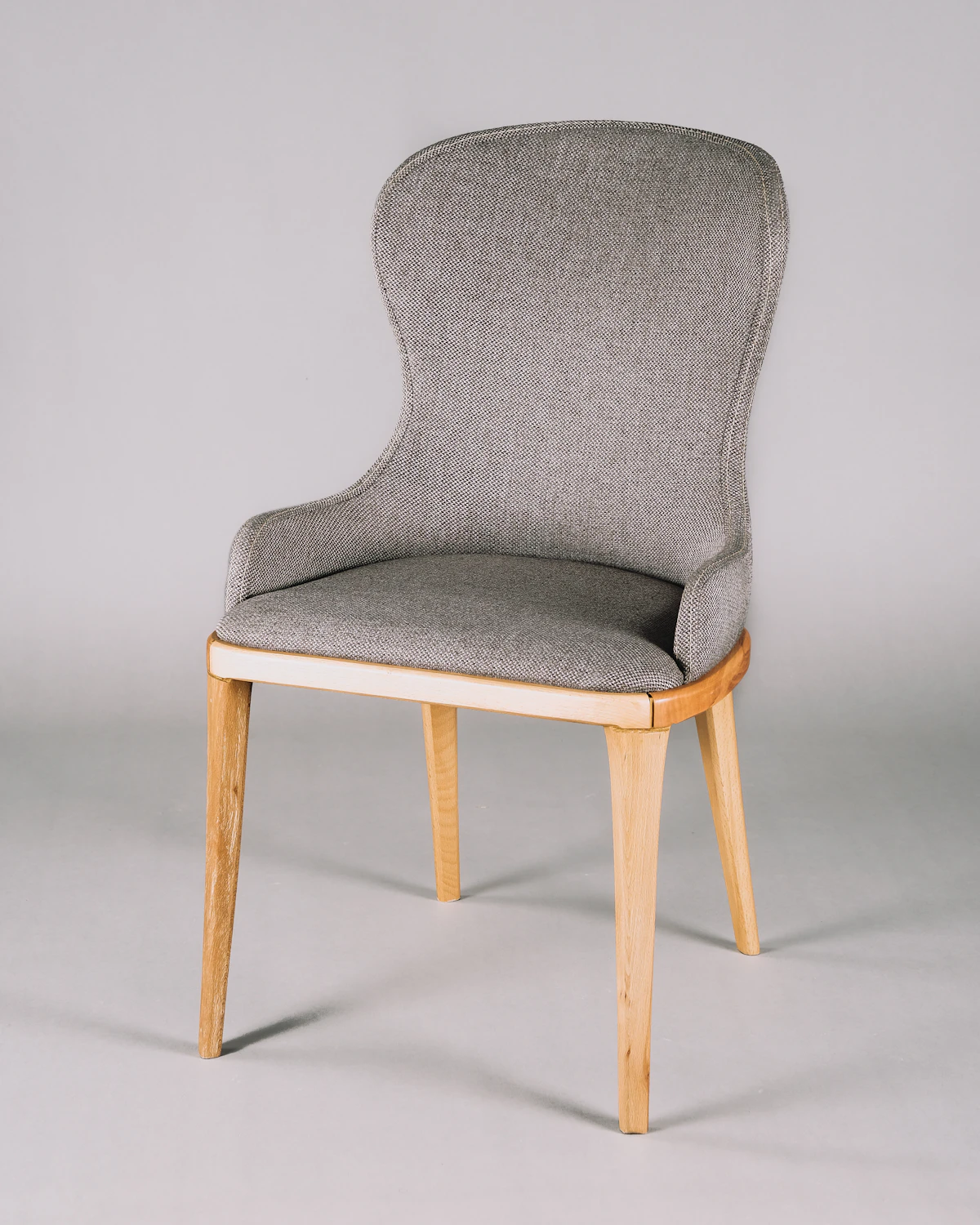
Dining chairs have a narrow band of correct dimensions and a wide range of what is sold.
- Seat height 45–47cm. Below 44 the table feels tall; above 48 your knees hit the apron
- The gap between seat and tabletop should be 28–32cm. Measure it — this single figure decides comfort more than the cushion does
- Seat width 45–50cm including any arms, or you cannot fit the number of chairs you calculated
- Depth 45–48cm. Dining chairs should not be lounge-deep; you sit forward to eat
- A back that stops at the shoulder blades, not the neck. Dining is not reclining
- Armchairs at the two ends only, if at all. Arms must clear the apron — check that they slide under, or the chair lives permanently pulled out
Buy the chairs and the table together, or at least measure the chairs before ordering the table. A 30cm gap is the difference between a table people linger at and one they leave.

Extending tables — worth it, with one caveat
A butterfly-leaf or draw-leaf table that runs 180cm daily and 240cm at Eid is an elegant answer to a real problem, and I specify them often. The caveat is mechanical: the mechanism is the part that fails, and a cheap extension mechanism in this climate — where the timber moves seasonally — will bind within two years.
Ask to open and close it three times in the showroom. It should run smoothly with one hand at each end and close with no visible line. If it needs a shove, walk away.
What I would specify
For a standard DHA dining room of about 16 × 12 feet (4.9 × 3.7m), a table of 220–240 × 100cm on twin pedestals or inset legs, in walnut or fumed oak, with eight chairs at 46cm seat height. That seats eight properly, ten at Eid, and leaves the service route intact.
The Astor is 260cm and takes ten; the Kingsley is 220cm and takes eight. Both are pedestal-based for exactly the reason set out above. Which timber to choose is a separate question, answered in walnut, oak or sheesham.
Sixty centimetres per person, one hundred centimetres deep, two metres of room around it. Every other dining table decision is decoration on top of those three numbers.
Bring your room dimensions to the showroom on Main Boulevard and I will draw the table into the plan before you order it. The full room layout — sideboard, lighting, rug and circulation — is covered in how to lay out a dining room.